
Learn · Grants and money
The Boiler Upgrade Scheme explained: £7,500 to £9,000 off a heat pump
The government pays £7,500 towards an air source heat pump, and £9,000 if you heat with oil or LPG and have no mains gas. You do not claim it yourself: it is applied for on your behalf and paid out once the system is in.
 By Rob Shute, heat pump and underfloor heating design engineer 8 November 2026 8 min read
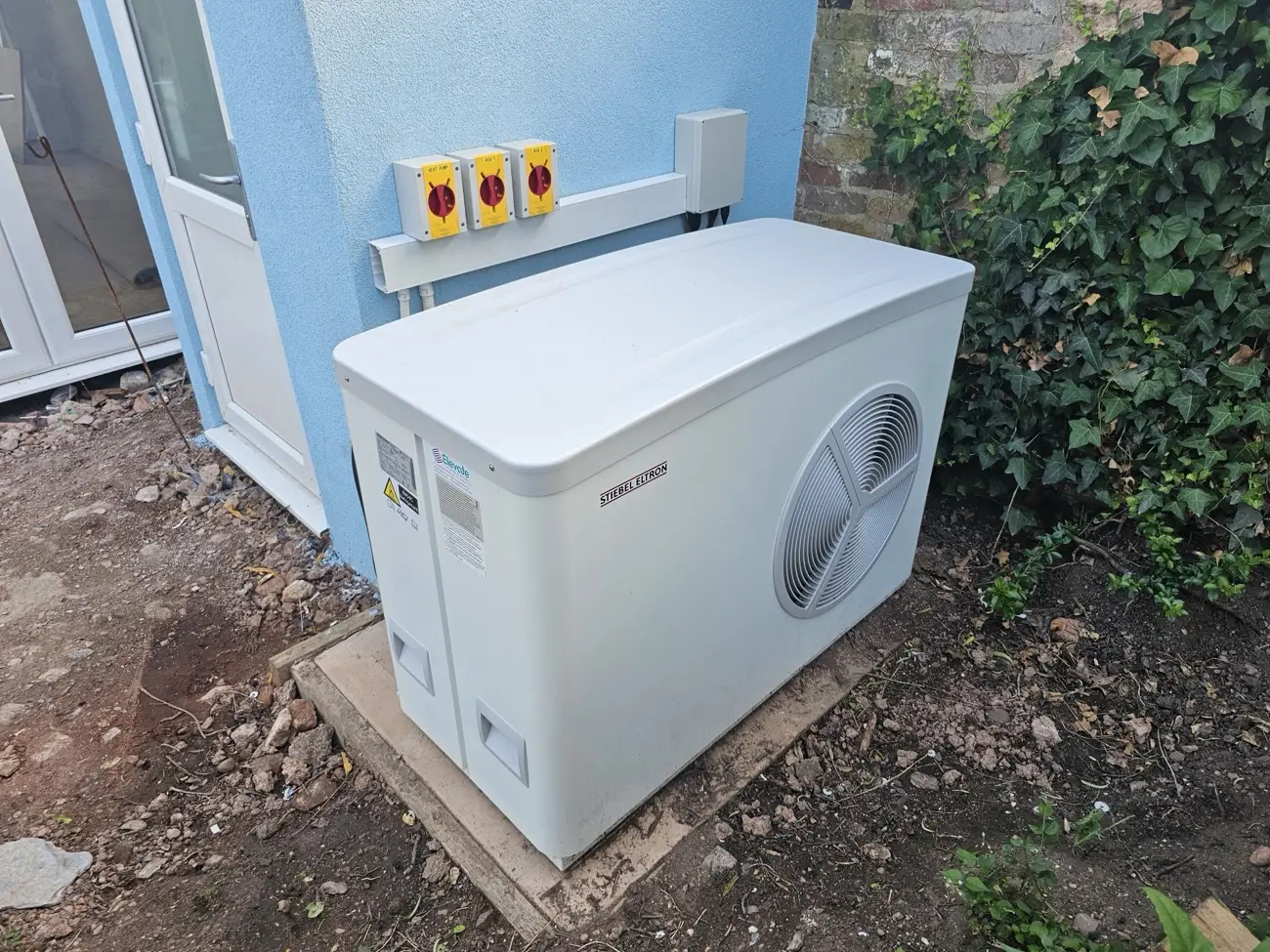
I process this grant on every heat pump we fit, so I get asked the same questions every week: am I eligible, how much do I get, when does it arrive, and what happens if it doesn't. Here's how it actually works, including the bit most people get wrong about the deadline.
How much is the heat pump grant worth?
Quick Answer: £7,500 for an air source heat pump. £9,000 if your home has no mains gas connection and you're replacing oil or LPG, until 31 March 2027.
The £9,000 isn't a separate grant. It's the standard £7,500 with an extra £1,500 added on top, and that extra £1,500 is the part with a deadline. For a ground source heat pump it's the same £7,500, with the same uplift available.
To get the higher rate, all of these have to be true:
- Your property has no mains gas connection, and no record of a gas meter point. A capped or clamped meter still counts as having mains gas.
- The system you're replacing runs on oil or LPG.
- The property isn't on a heat network.
- It isn't a new build.
- You're fitting an air-to-water or ground source heat pump. Air-to-air doesn't get the uplift.
If you're on mains gas, or on storage heaters, you get £7,500. That still covers more than half the cost of most of the systems we fit, and our prices page shows where that lands by size.
People on electric storage heaters often assume they're in the higher band because they're not on gas. They're not. The extra £1,500 is specifically for replacing a fossil fuel, and electricity isn't one.
Who qualifies for the Boiler Upgrade Scheme?
Quick Answer: Almost anyone who owns the property and is replacing an existing heating system, including landlords, second home owners and businesses.
The scheme is far broader than most people expect:
- Homes you rent out. Landlords can claim for rental properties, including properties owned through a limited company.
- Second homes and holiday homes.
- Park homes, where someone lives permanently.
- Businesses and non-residential buildings, including offices, churches and community centres.
- Self-builds, where you built it yourself or paid a builder, and it has never been owned by a business.
You can claim once per property, and if you own several properties you can claim on each one separately. The grant attaches to the building, not to you.
Two things to know. You have to become the legal owner of the heat pump once it's installed, so finance arrangements where you don't own the equipment aren't eligible. And self-builds can get the £7,500 but not the £9,000, even if the old heating was oil.
New builds that a developer is still building aren't eligible at all.
Do I need an EPC to get the heat pump grant?
Quick Answer: No. That requirement was removed on 28 April 2026.
This one changed recently and plenty of information online is still out of date. You no longer need a valid Energy Performance Certificate to apply. If your property happens to have one, its number goes on the application. If it doesn't, nobody makes you buy one.
What you do still need is evidence of what you were heating with before. Usually that means a recent fuel bill or receipt, and photographs of the old heating system.
Which brings me to the single most useful thing in this article.
Photograph your old boiler before anyone takes it out. I had a job where the house had been in the family for a hundred years, so there was no EPC, and the oil boiler was ripped out during the refurbishment before anyone thought to take a picture. Proving that house had been on oil meant going back through solicitors to track down old fuel bills from the previous owners. We got there, but it dragged on for months. One photo on a phone would have settled it in a second.
Do I need loft and cavity wall insulation to get the grant?
Quick Answer: No. The current scheme rules set no insulation requirement.
This is the most persistent piece of out-of-date information about the scheme, and it puts people off before they even ring. Loft and cavity wall insulation were once a condition of applying. Nothing in the current scheme guidance requires either one.
That said, insulation still matters enormously, just not as a box to tick. The better your house holds heat, the cooler the water can run, and the cheaper the heat pump is to run. So it changes your running costs rather than your eligibility.
Why do Boiler Upgrade Scheme applications get refused?
Quick Answer: Self-builds that can't prove the owner paid for the build. That's by far the most common reason, and almost the only one.
If you own your house, you're ripping out a fossil fuel system and putting in a heat pump, there's no real eligibility risk. I've never had one of those fail.
Self-builds are different. The rules say you have to have funded the build yourself, and the evidence asked for is detailed: invoices for the major works, foundations, roof structure. I've seen an application fail where a buyer had bought a shell of a house from a builder, with no internal walls, and finished it themselves. They'd done an enormous amount of work on it and it felt like a self-build to them, but because the builder had built and sold the shell, it didn't meet the definition.
So I ask the question up front now, before anyone commits to anything. If you're in a self-build, tell me early and we'll check it properly rather than finding out at the end.
Eligibility problems are almost always decided before a spanner is lifted. The right time to check is at the estimate, not when the application goes in.
How does the grant money actually reach me?
Quick Answer: It is paid to you once the system is in and the application has gone through. You do not claim it yourself, and you do not chase anybody for it.
This is the part people worry about most, so here it is in order.
The rules say the grant has to be deducted from the quote of the company holding the MCS certification. On our jobs that is Mere End, so you get two quotes: ours for the work, and a separate one from Mere End which shows their £825 plus VAT fee and the grant as a credit against it. In plain terms, that second quote tells you how much you will receive on a successful application.
Then the system goes in, it is commissioned, the application is made, and the money comes through to you.
Where we are also doing the installation, we handle it differently so you are not out of pocket while you wait: we take a deposit, and we do not invoice the balance until your grant has landed. The effect is the same as taking it off the price at the start.
The application itself is made by the company holding the MCS certification. Only they can apply. On our jobs, our installations are MCS certified through our MCS partner, Mere End Consultants, who make the application and issue your MCS certificate and insurance documents at the end.
That means three parties where a plumber is fitting the system: us designing and supplying it, your plumber installing it, and Mere End certifying it. Two contracts come to you to sign, one for you and one for your installer, and both are with Mere End rather than with us. I send an email explaining all of it when we get to that stage, with a link to their website, so nothing arrives as a surprise.
There's one cost here worth knowing about up front: MCS certification, registration and the grant application cost £825 plus VAT, and Mere End invoice you directly for it. We're not part of that payment.
How long does the whole process take?
Quick Answer: From saying yes to being warm, usually six to twelve weeks. The equipment order is the part that varies.
- You say yes to the estimate.
- Survey, within a couple of days. This is the room-by-room heat loss survey, and it's what confirms the estimate and the exact size of heat pump. We do this once a project is going ahead, not at estimate stage.
- MCS contracts signed, once the heat loss survey is done and the size is confirmed.
- Equipment ordered. This is the unpredictable one. I've had heat pumps arrive in a week, and I've ordered two recently where we're looking at six to eight weeks. A few suppliers can't give a date at all at the moment. If that happens we can specify a different supplier, so it's a delay rather than a dead end.
- Indoor work while we wait. Your hot water cylinder and the internal pipework can go in during that gap, so everything is ready to connect the outdoor unit when it lands.
- Installation, about a week, then commissioning.
- Paperwork to Mere End, who apply for the grant and issue your certificates. You get a full handover pack.
The order is the bit nobody can promise. Everything else on that list I control; supply chains I don't. It's the single biggest reason to start earlier than you think you need to.
When is the last date to get the £9,000 heat pump grant?
Quick Answer: The extra £1,500 ends on 31 March 2027. Leave yourself two to three months before that, and more if you can.
Work backwards from the deadline and you can see where the risk sits. The survey is quick and the installation is about a week. The unknown is the equipment, which has run to six to eight weeks this autumn.
If you ring me in January 2027 wanting a heat pump with the higher grant, my honest answer is that it would be close but it's probably doable, depending on how busy we are and whether we can get the heat pump in time. By February it starts depending on luck. And late March will be the busiest fortnight the industry has had in years, because everyone who left it late will be trying to finish at once.
If you're on oil or LPG and you've been thinking about it, the sensible thing is to get an estimate now. An estimate costs you nothing and commits you to nothing, and it tells you whether you're in the higher band before the timing matters.
What happens to the grant after 31 March 2027?
Quick Answer: It goes back to £7,500. The scheme itself continues to 2030.
Two separate things end on 31 March 2027, which is why there's so much confusion about it:
- The extra £1,500 for oil and LPG homes stops, so the grant returns to the standard £7,500.
- 0% VAT on heat pump installation ends, and the rate becomes 5%.
What doesn't end is the scheme. The Boiler Upgrade Scheme was extended to 2030 in April 2026, and the money hasn't been a problem: take-up has been lower than the government hoped. So if you're on mains gas and not in the higher band anyway, there's no cliff edge coming for you and no reason to rush a decision you're not ready to make.
The deadline is real but it's narrow. It matters enormously if you're on oil or LPG, because it's £1,500 plus the VAT change. If you're on mains gas, the £7,500 is still there in April.
If you're weighing a heat pump against staying on gas, the running cost sum is in our comparison guide.
Find out which grant band you're in.
An estimate costs nothing and tells you where you stand.
Get in touchFrequently asked questions
Can I get the Boiler Upgrade Scheme for a rental property?
Yes. Landlords can claim for properties they rent out, including properties owned through a limited company. You can claim once per property, and on each property separately if you own several.
Do I have to pay the grant money back?
No. It is a grant, not a loan. It is applied for on your behalf once the system is commissioned, and paid out after that.
Can I claim the grant if I have already had the heat pump installed?
Possibly, but the window is tight: the application has to be properly made within 120 days of the system being commissioned. Talk to us before the installation rather than after it.
Does the grant cover underfloor heating or new radiators?
The grant is for the heat pump itself. Radiators, underfloor heating and a hot water cylinder are part of the installation we quote for, and the grant reduces what the whole job costs you.
What happens if the grant application is refused after my heat pump is fitted?
It has not happened to us, because we check eligibility before the work starts rather than hoping it works out at the end. The one case I have seen fail elsewhere was a self-build where the owner could not prove they had funded the build.
About the author. I'm Rob Shute, co-founder of Elevate South West. I've designed heat pump systems since 2014, several hundred of them, and underfloor heating since 1999. I handle the grant paperwork on every heat pump we fit.
Sources
- Apply for the Boiler Upgrade Scheme — GOV.UK
- Boiler Upgrade Scheme, scheme overview — Ofgem
- Grant amounts, the £1,500 uplift and its conditions, the EPC change of 28 April 2026, the 120-day rule and the extension to 2030 — Ofgem Installer Guidance
- 0% VAT on installed heat pumps until 31 March 2027, then 5% — HMRC VAT Notice 708/6
- Find your EPC — GOV.UK
Checked 7 November 2026. Government guidance is versioned and changes, so check the current version before relying on it.