
Learn · Comparisons
Heat pump vs gas boiler: which is right for your home?
A new gas boiler costs £2,000 to £3,000. A heat pump costs £4,000 to £8,000 once the grant comes off. Whether it is then cheaper to run comes down to one number: how efficiently it works in your house.
 By Rob Shute, heat pump and underfloor heating design engineer 8 November 2026 7 min read
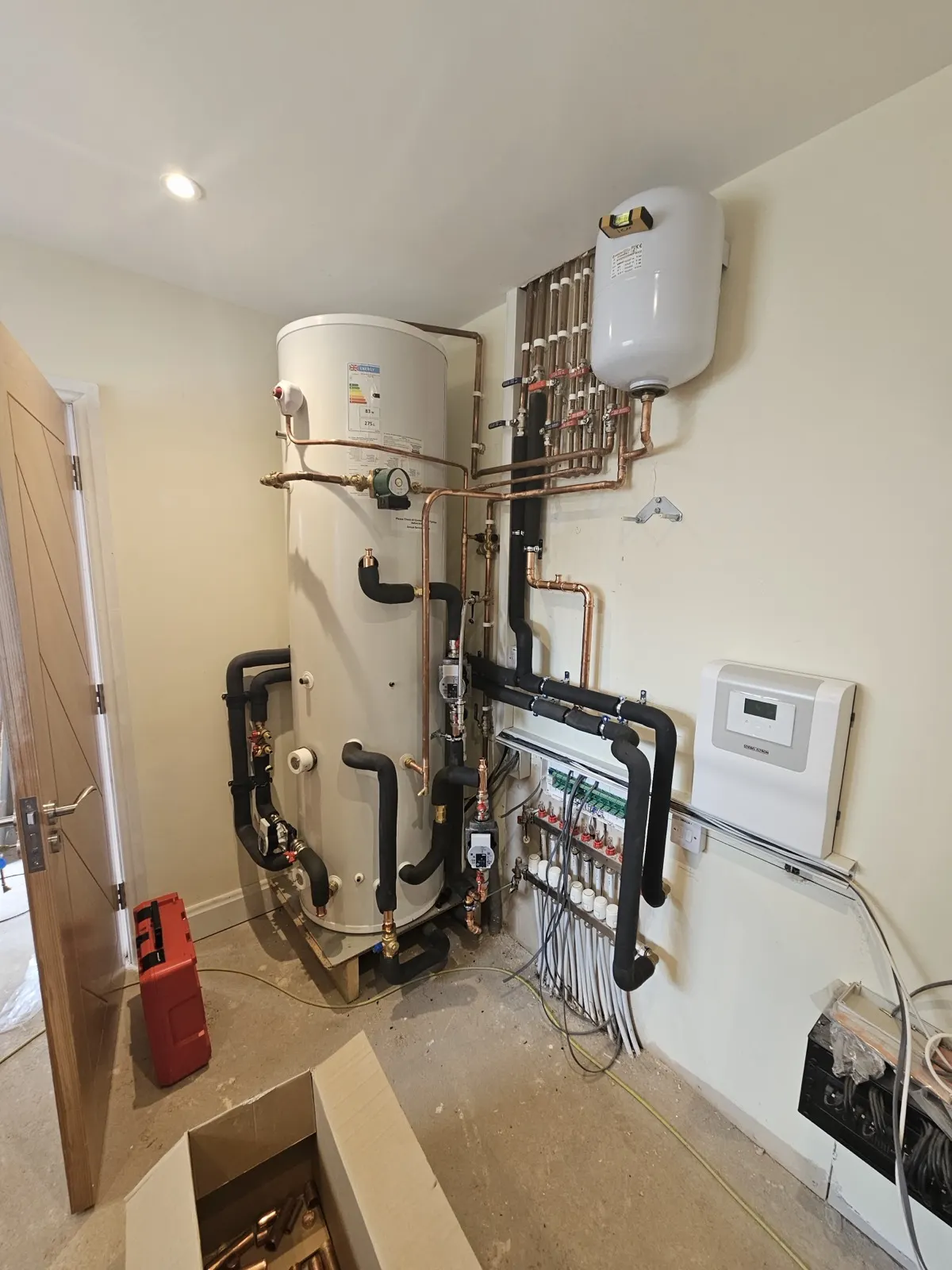
When someone with a perfectly good gas boiler asks me about a heat pump, my first question is why. One customer said, 'We just want to be green.' I can't argue with that; for everyone else, here's how I'd weigh it up.
The short answer
- Working gas boiler, average insulation: it's close. Running costs are similar at today's prices, and the heat pump costs more to fit even after the grant.
- Well-insulated house: a heat pump can run cheaper than gas. A house that holds its heat can be warmed with cooler water, and the cooler the water, the more efficiently the heat pump runs.
- Solar panels or a battery already: it strengthens the case, because you're covering some of the electricity yourself.
- Off mains gas, on oil or LPG: not a close call. A heat pump, with a £9,000 grant until 31 March 2027.
- On direct electric, such as storage heaters: also not a close call. You put one unit of electricity in and get one unit of heat out. Put that same unit into a heat pump and you get three or four.
Should I replace a working gas boiler with a heat pump?
Quick Answer: Only if the numbers work for your house, or if coming off gas matters more to you than the cost.
Most people have heard heat pumps are really cheap to run. Against mains gas right now, that isn't a given: electricity costs far more per unit, so the heat pump has to work efficiently just to break even.
What tips it is your insulation, whether you have solar panels or a battery, and how much coming off fossil fuels matters to you. A full heat loss survey settles the rest.
How much does a heat pump cost compared to a new gas boiler?
Quick Answer: A straight boiler replacement is £2,000 to £3,000. A heat pump is £4,000 to £8,000 once the £7,500 grant comes off.
The spread is wider than people expect because the job varies: a small heat pump in a well-insulated bungalow is a different project from a large one, or more than one, in a big old house. Our heat pump prices page breaks it down by size.
One cost sits outside that range, and I'd rather you heard it from me now than found it later:
- MCS certification, registration and the grant application: £825 plus VAT. You're invoiced for this directly by Mere End Consultants, our MCS partner. We're not part of that payment.
A new hot water cylinder and some bigger radiators, or underfloor heating, are a different matter: those are part of the job, not an extra, and our prices include them. Plan for a day or two without hot water while the cylinder goes in.
Is a heat pump cheaper to run than a gas boiler?
Quick Answer: It depends on its SCOP. At October 2026 prices, a heat pump beats gas once it produces more than about 3.3 units of heat for each unit of electricity.
SCOP (seasonal coefficient of performance) is the units of heat you get for each unit of electricity, averaged over a year.
Here's the sum. From 1 October 2026, the average price cap rates are 26.32p per kWh for electricity and 7.97p per kWh for gas. A gas boiler can't make more heat than the gas it burns, so every unit of heat from gas costs at least 7.97p.
| Heating | Cost for each unit of heat |
|---|---|
| Gas boiler | 7.97p or more |
| Heat pump, SCOP 2.8 | 9.4p |
| Heat pump, SCOP 3.5 | 7.5p |
| Heat pump, SCOP 4 | 6.6p |
| Heat pump, SCOP 4.5 | 5.8p |
Average unit rates only, no standing charges. Price cap unit rates include VAT.
2.8 is the lowest SCOP the grant allows, and roughly what a poorly insulated house gets. A well-insulated house can reach 4.5 or 5, higher with the better models.
Your house decides your running costs more than anything. The better it holds heat, the cooler the water can run, and the cheaper every unit of heat becomes.
Cheaper electricity tariffs, solar and batteries
Some suppliers offer heat pump tariffs that run the heat pump and heat your hot water when electricity is cheapest.
Quite a few people now start with just a battery, charge it overnight on a cheap tariff and use it during the day, then add solar panels later.
My instinct is that gas, oil and electricity prices are all heading up. Panels or a battery give you some cover against the electricity side.
How can I compare heat pump and gas running costs for my house?
Quick Answer: You can work out what you spend now on your own. The heat pump side needs a heat loss survey, because the efficiency figure can't be guessed.
You can get half of this done yourself in ten minutes:
- Find your EPC. Assuming you have a valid one, it's on the government's EPC register. Add together the space heating and water heating figures. If your house hasn't been sold or let in years you may not have one, and then it's a job you'd have to pay for.
- Work out your current cost. If you're on gas, multiply that total by 7.97p.
The heat pump side is where it stops being a DIY job. To know what a heat pump would cost you, you need its SCOP, and the SCOP depends on the water temperature your house actually needs. That comes out of a room-by-room heat loss survey. Guess it and you're not estimating, you're hoping: pick a flattering number and the running costs look far cheaper than they'd ever be.
So by all means find your EPC and your current bill. For the other half, get someone to do the survey. When we design a system, the performance estimate puts your current running costs next to the heat pump's, based on real measurements of your house.
Anyone who quotes you a heat pump running cost without surveying your house has guessed at the number that matters most.
Does a heat pump feel different to a gas boiler?
Quick Answer: Radiators feel cooler to the touch, but your house still reaches the same temperature.
- Radiators run cooler. A boiler heats water to around 80°C. A heat pump runs cooler, and how much cooler depends entirely on your house: a well-insulated one might run at 35°C, while 50°C is high in heat pump terms. If a system needs 50°C to work, the radiators probably haven't been sized properly. Bigger radiators push that number down, and a lower number means a more efficient heat pump.
- The house still gets just as warm. This is the one that catches people out. The radiators feel cooler to the hand, so it feels as though something's wrong, but the house reaches exactly the temperature you set.
- Underfloor heating feels best. People who move from radiators to underfloor heating find it far more comfortable, and it reaches the same room temperature with water that's cooler again. That's why it's the most efficient way to run a heat pump.
- Hot water is the same day to day. We size the new cylinder for your household. There's no noticeable difference for a full house on a busy morning.
- Cold weather is designed for. We design to the MCS outdoor design temperature for your area.
What outdoor temperature do you design for in Exeter?
There isn't a single figure for Exeter, and I'd be making it up if I gave you one. The MCS design software picks the nearest location to your postcode and then adjusts for your altitude, so a house at the top of Stoke Hill gets a different number from one down by the quay. Across the South West the figures sit around freezing: Plymouth is about minus 1.5.
What we don't do is design for the coldest night in a decade. We might see minus 5 or minus 10 once in a blue moon down here. Size a system for that and you've got a heat pump that's oversized every other day of the year, which costs you more to buy and runs less efficiently. It's a trade worth understanding: in a genuinely extreme cold snap, a system designed properly may not quite hold the temperature it does the rest of the time.
The design temperature isn't a regional number you can look up. It comes from your postcode and your altitude, and it's set for your project.
Is a heat pump more expensive to maintain than a gas boiler?
Quick Answer: Not really. It needs an annual service, just like a boiler.
- Service it every year. It keeps the manufacturer's warranty valid, and it's something we do whoever fitted the system.
- Warranties vary by brand. Vaillant gives 7 years to Vaillant partners, which we are. Clivet, which we also fit, gives 10.
- The big repair is the compressor. Out of warranty, that's a couple of thousand pounds. On a 12-year-old unit that's done well, a new heat pump for not much more is often the better call.
When is a heat pump the obvious choice?
Quick Answer: When you're on oil, LPG or direct electric and your house is well insulated.
- Oil or LPG with good insulation. The strongest case of all, and the only one that gets the higher £9,000 grant, which applies to homes with no mains gas connection until 31 March 2027.
- Direct electric heating, such as night storage heaters or an electric boiler. An electric boiler is 100% efficient: one unit in, one unit out. Put that same unit of electricity into a heat pump and you get three or four units of heat. The grant here is £7,500 rather than £9,000, because you're not replacing a fossil fuel, but the running cost case is about as clear as it gets.
- Solar panels or a battery already. You're covering some of the electricity yourself.
- A well-insulated house. The higher the SCOP, the further ahead the heat pump gets.
- You want to come off fossil fuels. A perfectly good reason on its own.
If you're on oil, LPG or storage heaters and your house is well insulated, this isn't a close call.
And the other side: if your gas boiler works, your insulation is average and your only reason is saving money, the numbers may not stack up yet. I'll tell you if that's the case.
Two deadlines worth knowing
The Boiler Upgrade Scheme pays £7,500 towards an air source heat pump. Until 31 March 2027 there's an extra £1,500 on top for homes with no mains gas connection that are replacing oil or LPG, which is where the £9,000 figure comes from. After that date the extra £1,500 stops and the grant is £7,500.
The 0% VAT on installed heat pumps ends the same day and goes to 5%.
The scheme itself isn't going anywhere: it was extended to 2030 in April 2026. It's the extra £1,500 and the VAT rate that have the deadline. We've written up how the grant works in full, including who qualifies and how the money reaches you.
Heat pump or boiler? Let's look at your house.
Send us your plans or a few photos and we'll tell you honestly which way the numbers fall.
Get in touchFrequently asked questions
Can I get a grant to replace a gas boiler with a heat pump?
Yes. The Boiler Upgrade Scheme gives £7,500 towards an air source heat pump. Homes with no mains gas connection replacing oil or LPG get £9,000 until 31 March 2027. Our installations are MCS certified through Mere End Consultants, who make the grant application.
Do I need solar panels to run a heat pump?
No. Solar panels or a battery bring your running costs down, but a heat pump runs fine without them.
Will a heat pump keep my house warm when it is freezing outside?
Yes. We design it to the MCS outdoor design temperature for your postcode and altitude, which down here is around freezing. In a rare extreme cold snap the house might sit a couple of degrees cooler than usual.
Do I need new radiators if I switch from a gas boiler to a heat pump?
Usually some, yes. Heat pumps run cooler water, so radiators sized for a boiler are often too small. We keep the same style where we can, just longer and deeper.
About the author. I'm Rob Shute, co-founder of Elevate South West. I've designed heat pump systems since 2014, several hundred of them, and underfloor heating since 1999. If a project goes ahead, the estimate is confirmed by a room-by-room heat loss survey before anything is ordered.
Sources
- Price cap unit rates, 1 October to 31 December 2026 — Ofgem
- Boiler Upgrade Scheme grant amounts — GOV.UK
- 0% VAT on installed heat pumps until 31 March 2027, then 5% — HMRC VAT Notice 708/6
- Find your EPC — GOV.UK
Checked 7 November 2026. Government guidance changes, so check the current version before relying on it.